What is credit line management?
Every card account has a credit limit, and the total of those limits is the lender's committed exposure. Line management is the ongoing practice of adjusting limits as accounts age and borrowers' behavior becomes clearer. Increases can reward good customers and support balances. Decreases and holds can reduce exposure where risk has risen.
Most line strategies are rules: who is eligible, how big a change, and what caps apply. The hard part is knowing in advance what a rule will actually do to your book.
How to build a credit line increase strategy
A typical increase strategy starts with eligibility and then sizes the change. Common building blocks include:
- Seasoning: a minimum number of months on book before an account qualifies
- Utilization: a range of balance-to-limit that signals a need for more room without signaling stress
- Change size: a percentage of the current line
- Per-account cap: the most any single line can move
- Maximum line: a ceiling no account can exceed after the change
When a credit limit decrease or hold makes sense
Decreases are usually aimed at accounts where unused lines represent risk the lender no longer wants to carry, such as high-risk segments with large undrawn availability. Holds are the quieter option: keep certain accounts out of an increase program, for example recently delinquent accounts, without lowering their line.
Because decreases affect customers directly, teams tend to want a clear record of why each account was selected and which rule applied. That record matters as much as the projected exposure change.
How Aarvion tests line proposals
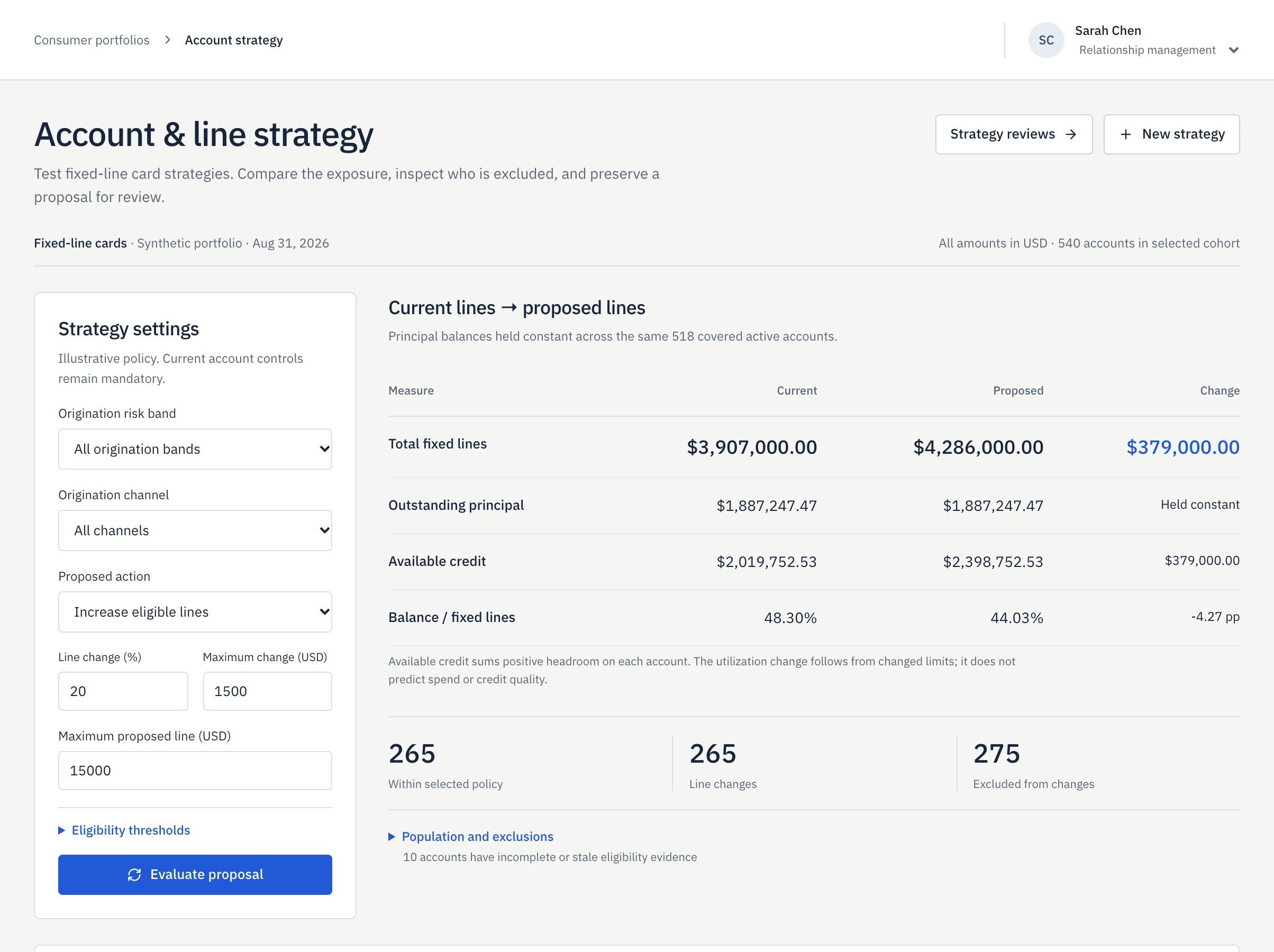
In Aarvion you define a fixed-line card proposal as an increase, decrease or hold, using a percentage, a per-account cap, a maximum line, and seasoning and utilization rules. The screen shows existing versus proposed commitment, how many accounts are eligible, how many would actually change, and which accounts were excluded and why.
Saved proposals go to review. The candidate list can be exported so your team can carry it into the systems you already use. Aarvion does not change limits on customer accounts. It helps you see the effect of a rule and keeps the record of who proposed and approved it.
Why exclusions deserve as much attention as eligible accounts
A rule that looks generous on paper can touch far fewer accounts than expected once seasoning and utilization filters apply, and a decrease rule can reach accounts no one intended. Listing exclusions with their reason shows you whether the rule is doing what you meant.
Pair line work with portfolio views of utilization, 30+ delinquency and vintage performance to check that the segments you target are behaving the way your assumptions say.
What your team still decides
Your credit strategy team sets the rules, chooses which proposal to take forward, and owns the decision to change any line. Every AI step in Aarvion is checked against your own credit rules, which can allow it, hold it for the right signer, block it or stop everything, and each step is recorded with who proposed it, which rule applied, who approved it and when. A 90-day pilot on one workflow is the usual way to start.