What is a collections strategy?
Collections strategy is the set of rules for working delinquent accounts: which accounts get outreach, which are offered a payment arrangement or hardship assessment, which go to a specialist, and in what order. It is usually segmented by days past due (DPD), balance and product.
Good strategy is less about any one treatment and more about matching treatments to accounts and checking whether the match worked.
How to measure cure rate without fooling yourself
A cure is usually defined as a delinquent account returning to current. The cure rate is the share of treated accounts that cure within a set window. On its own it can mislead: an account that cures this month and is 30 days late again two months later has not really been fixed.
That is why teams pair cure rate with repeat delinquency after cure and, for arrangements, whether the borrower kept to the plan. Window length matters too. Comparing a 60-day result for one treatment with a 90-day result for another is not a fair comparison.
- Observed cure: returned to current within the window
- Repeat 30+ after cure: cured, then fell 30 or more days behind again
- Kept payment arrangement: arrangement made and honored through the window
Why immature cohorts distort collections analytics
If a cohort was treated three weeks ago, a 90-day outcome does not exist yet. Including those accounts drags the measured cure rate down, or worse, makes a newer treatment look better because its failures have not happened yet. The safe approach is to compare treatments only on cohorts old enough to have complete follow-up for the chosen window.
How Aarvion compares treatments
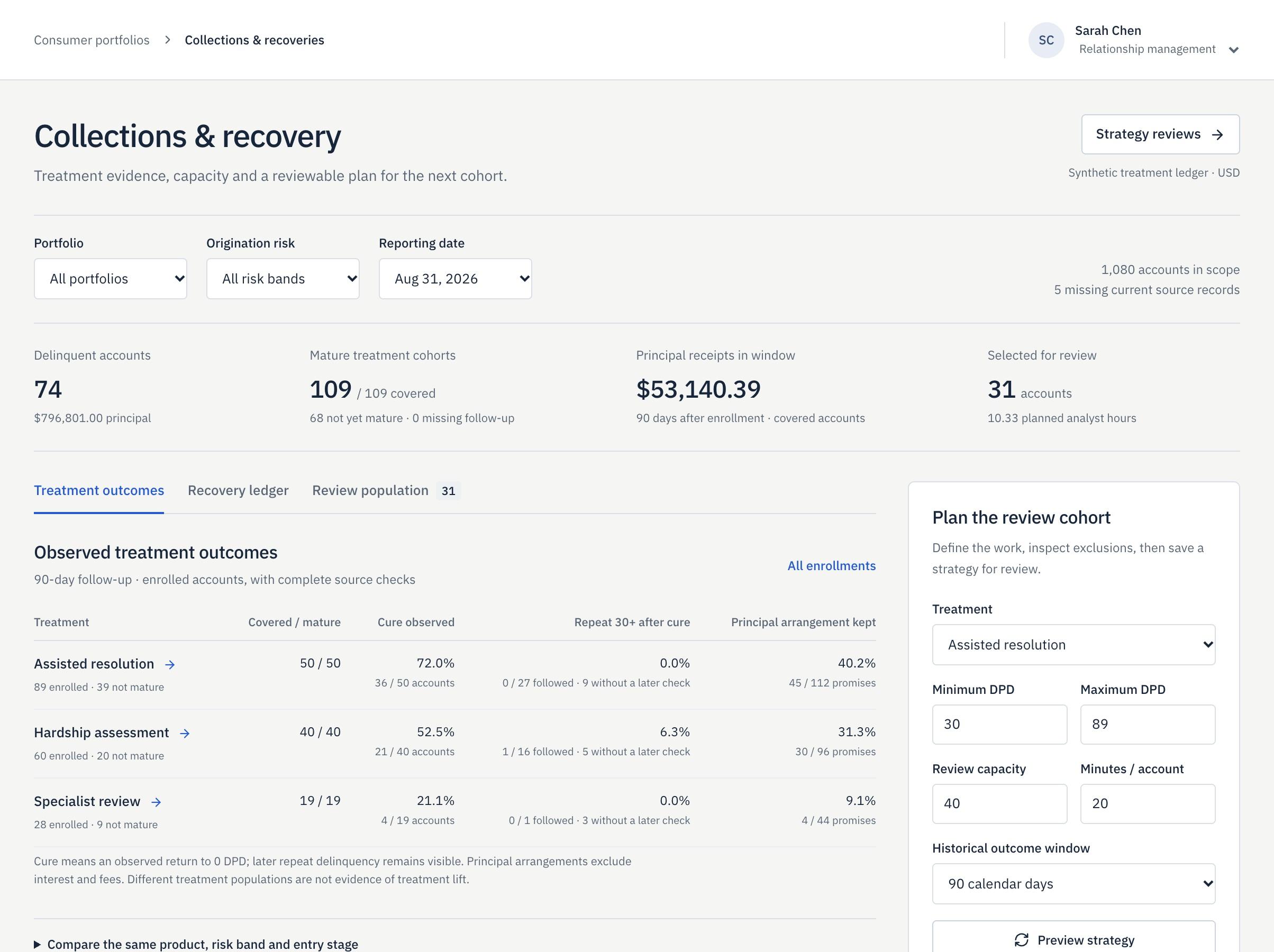
Aarvion shows delinquent accounts and principal by product and DPD range. It compares treatment outcomes, for example assisted resolution, hardship assessment and specialist review, on observed cure, repeat 30+ delinquency after cure, and kept payment arrangements over a 60 or 90-day window.
Comparisons only use mature cohorts with complete follow-up, so every treatment is judged on the same footing. Numerators and denominators are visible, with account-level records and CSV downloads behind each figure.
Planning a review cohort around analyst capacity
Knowing which treatment works is only useful if your team can act on it. In Aarvion you plan a review cohort by treatment, DPD range and the analyst hours available, so the plan fits the capacity you actually have. The plan is saved and sent for review.
Recoveries and charge-off trends sit alongside this in the portfolio and vintage views, so collections leads and risk managers work from the same numbers.
What your collections team still decides
Aarvion does not contact customers or change accounts. Your team decides which treatments to offer, how to staff them, and how to handle each borrower. Every AI step is checked against your own credit rules and recorded with who proposed it, which rule applied, who approved it and when. Most teams start with a 90-day pilot on one workflow.