Where credit approval workflows break
Approval often depends on someone working out the right approver by hand. Relationship exposure has to be added up across facilities, and the worst grade identified. Requests go out by email, conditions get written into one version of the memo and not another, and committee votes are recorded in minutes that live apart from the file.
- Exposure is aggregated by hand, so routing can be wrong
- Approvals are given on stale grades or outdated terms
- Conditions and votes are scattered across emails and minutes
- Approved terms are not checked against the signed agreement
How Aarvion routes and records approvals
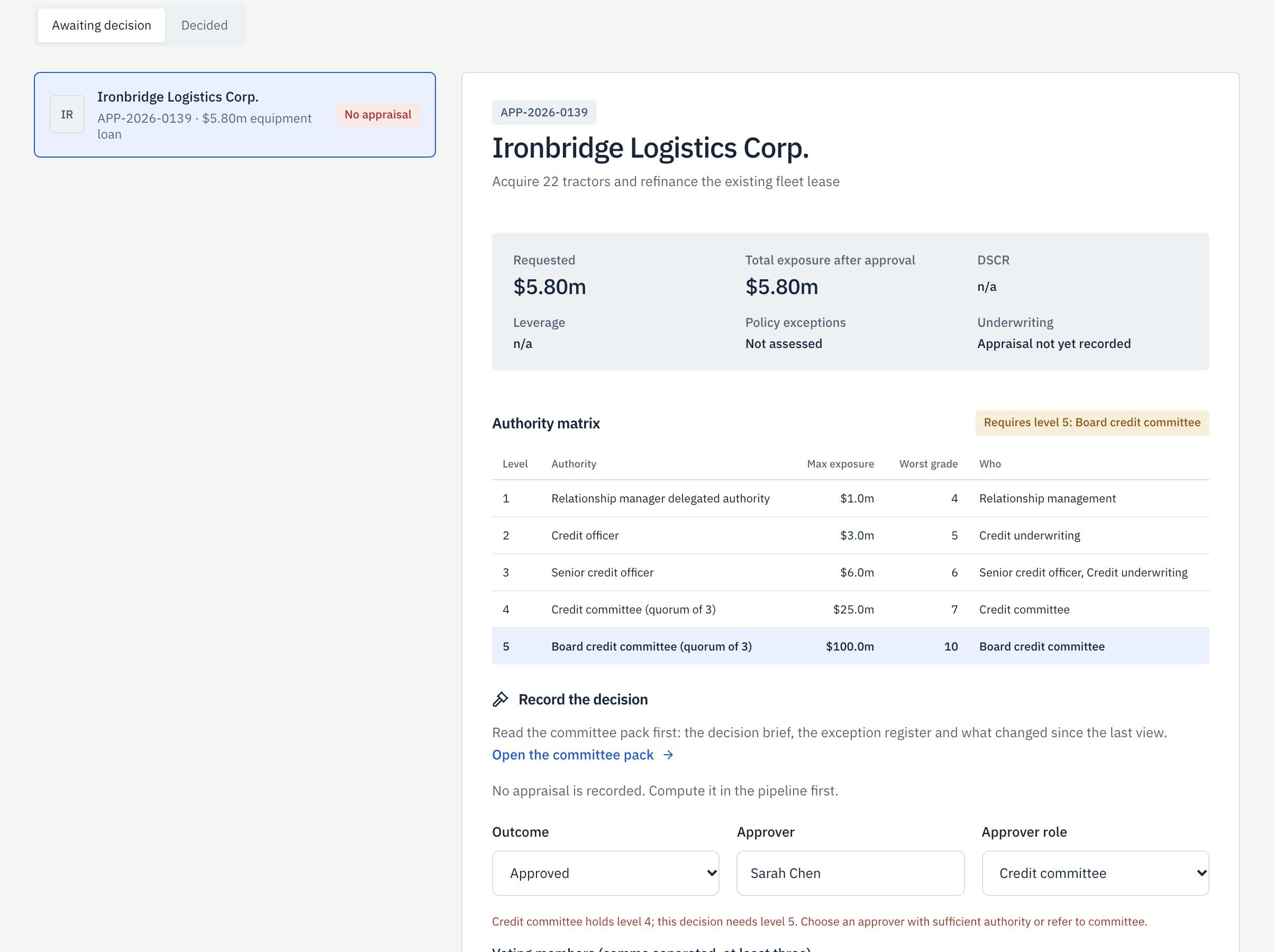
Aarvion loads your delegated authority matrix, for example RM delegated authority, credit officer, senior credit officer, credit committee and board credit committee, with limits by maximum exposure and worst grade. Each request is checked against it and routed to the right level. Approval requires a current risk grade assignment, so a request cannot be approved on a grade that no longer reflects the file.
The approver records the outcome, the rationale and any conditions. For committee decisions, the voting members are recorded too. At closing, Aarvion compares the approved terms, the executed terms in the signed agreement and the proposed booking terms. Missing terms and material variances block confirmation until someone resolves them, and then booking in the core is verified.
What stays with your approvers
Aarvion does not approve loans. It checks who is allowed to, routes the request, and records what they decided. Approvers and committees keep full control of the decision, the conditions and the structure.
Every AI action is checked against your bank's own credit rules: allowed, held for the right signer, blocked, or all AI stopped. Every decision is recorded with who proposed it, which rule applied, who approved it and when.
How approval fits the full loan lifecycle
Approval sits between the credit memo and closing. Upstream, the memo, the spread and the risk grade give the approver what they need. Downstream, approved terms are checked at closing and carried into servicing and covenant tracking.
Aarvion is built for credit teams at banks, credit unions and commercial lenders. It works alongside your existing loan platform and core banking system. A 90-day pilot on one workflow and one loan segment is the usual starting point.