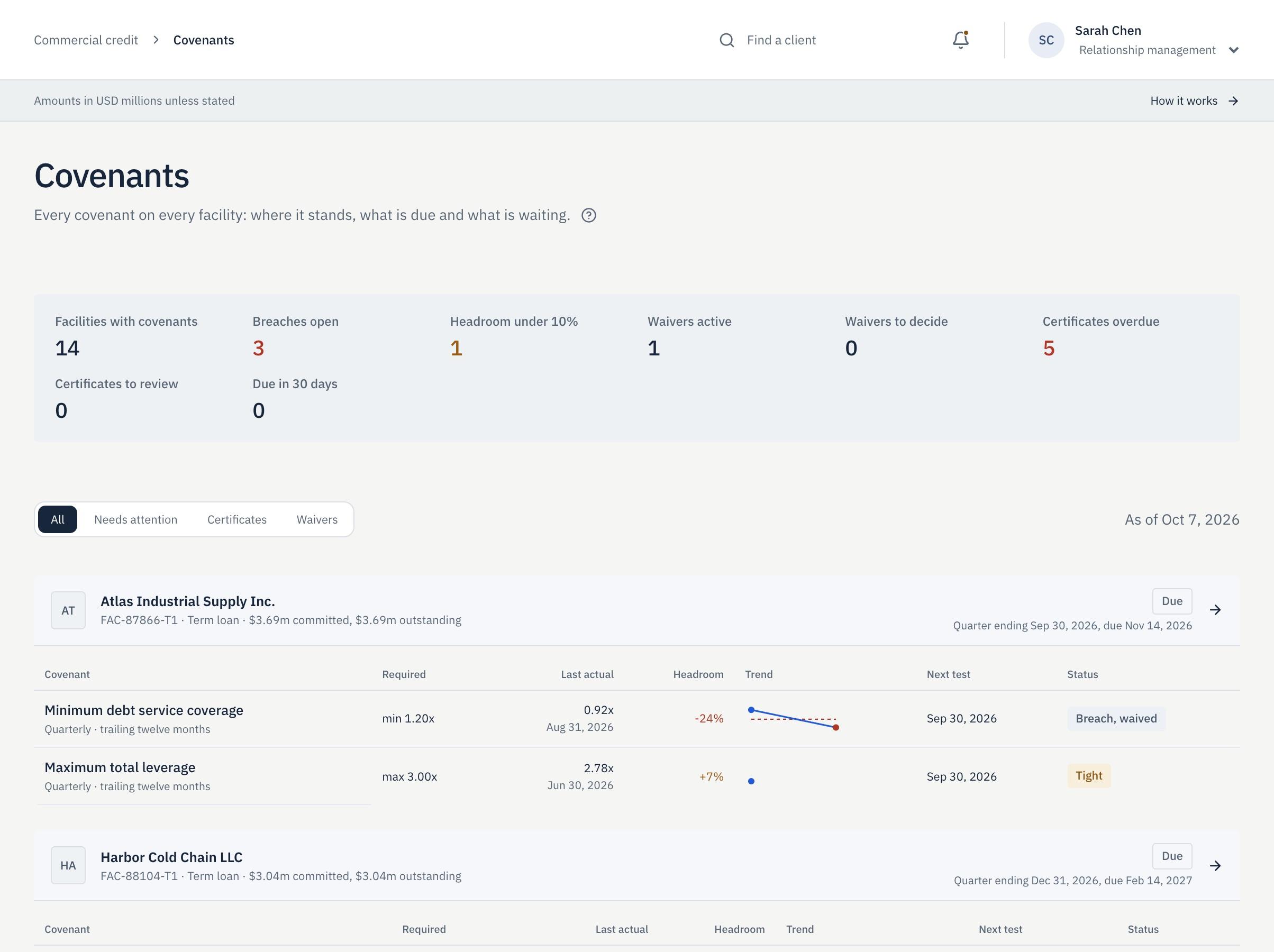
What are loan covenants?
Covenants are the promises a borrower makes in the loan agreement. Financial covenants set measurable limits, such as a minimum debt service coverage ratio, a maximum leverage ratio or a minimum tangible net worth. Reporting covenants require the borrower to send financial statements, tax returns, borrowing base certificates or compliance certificates by certain dates. Other covenants restrict actions like new debt or asset sales.
Covenants give the bank an early warning. A covenant that is close to its limit, or a borrower who stops sending reports on time, is often the first visible sign of trouble.
Why covenant tracking falls behind
In many banks, covenants live in a spreadsheet or a tickler system that tracks dates but not results. Testing a covenant means pulling the borrower's latest statements, recalculating the ratio the way the agreement defines it and recording the outcome. With hundreds of facilities, that work tends to slip until a breach is found late.
- Ticklers track due dates but not test results or headroom
- Ratios are recalculated by hand from each new statement
- Waivers and amendments are hard to find later
- Missing compliance certificates go unnoticed
How Aarvion monitors covenants
Aarvion keeps every covenant on every facility and tests each one. For each covenant you see the required level, the last actual, the headroom and the trend over time, so a covenant that is tightening is visible before it breaks. Breaches and waivers are recorded with the covenant they apply to.
Compliance certificates and reporting requirements are tracked with ticklers, so the team knows what is due, what has arrived and what is late. Facilities, payments and past-dues come from your core banking system, so the covenant view sits next to actual payment behavior.
What stays with your portfolio team
Deciding what to do about a breach is a credit decision. Whether to waive, amend, reprice or downgrade stays with your credit officers and approvers. Aarvion shows the facts and records the outcome.
Every AI action is checked against your bank's own credit rules: allowed, held for the right signer, blocked, or all AI stopped. Each decision is recorded with who proposed it, which rule applied, who approved it and when.
How covenants connect to reviews and risk grades
Covenant results feed the portfolio monitor, which ranks borrowers by review priority and risk signals, and the annual review drafts Aarvion prepares before they are due. A change in the borrower's financials marks the risk grade assignment stale, so the reviewer is prompted to look again.
Aarvion is built for credit teams at banks, credit unions and commercial lenders, and works alongside your loan platform and core. A 90-day pilot on one workflow and one loan segment, such as covenant testing for commercial real estate, is the usual start.
Commercial Credit
Annual loan review software that drafts reviews before they're due
Commercial Credit
Loan risk rating software that keeps the reviewer's grade
Commercial Credit
Credit approval workflow built on your delegated authority
Guide · 6 min read
Loan Covenants Explained: Financial Covenants, Headroom and Monitoring